Labour's disastrous recent local election results may end up being the final blow to Sir Keir Starmer's premiership – but his problems didn't start there.
Despite his government being elected with a huge majority of 172 in July 2024, Sir Keir's support base was described as 'wide but shallow'.
Big promises on key issues, including easing the cost of living, restoring the NHS and dealing with an acute housing crisis, had been the cornerstone of his pledges to win over the electorate.
Now, just 679 days later, he is facing mounting pressure to resign, with the possibility of becoming the shortest-serving Labour prime minister in history.
If he is forced to resign, his replacement will become the seventh prime minister in 10 years, following years of increasing instability and high turnover at the top of government.
Cost of living
Sir Keir has emphasised that cutting the cost of living is his government's "number one priority".
However, consumer price inflation has increased from 2.2% to 3.3% under Starmer - and prices may yet rise further as the impacts of trade disruption from conflict in the Middle East are fully realised.
A series of external shocks, including Donald Trump's sweeping tariffs on US imports, and the outbreak of war in Iran in the lead-up to the government's spring economic statement, have impacted the economy and contributed to persistent inflation.
Sir Keir has pledged to make the UK the fastest-growing economy in the G7 by the end of this parliament. While UK economic growth has been slow - at 1% in 2025 - the country is not alone in facing economic challenges, and is currently outperforming several G7 peers as the third-fastest growing economy in the group over the past 12 months.
Data released on Thursday also showed faster-than-expected growth in March, the first month of the Iran war. Those figures also placed the UK as the fastest-growing G7 country in the first quarter of 2026, although Japan is yet to release data for that period.
Tax thresholds
While the government has repeatedly promised not to increase taxes for working people, 'stealth' tax increases through frozen tax thresholds mean many are paying more.
Tax thresholds have been frozen since 2021 and are set to remain frozen until 2028.
That means that as inflation leads to wage increases, we end up paying more tax on a higher proportion of our earnings - a process known as fiscal drag.
Missing housebuilding targets
Slow economic growth and persistent cost-of-living issues may have contributed to the prime minister's unpopularity, but they have also made it harder to deliver in other areas, like housing.
Sir Keir has said he wants to "build baby, build", summing up his government's ambitious promise of creating 1.5 million additional homes before the next general election.
Achieving it would represent a higher level of housebuilding than at any point since the post-war period.
With the halfway point of this parliament fast approaching, housing delivery has fallen to its lowest level in nine years.
Housebuilders have raised concerns that building is "flatlining" and no longer viable - particularly in London, where only 5,000 new homes were started in the latest year, against a target of 81,000.
Based on analysis of new Energy Performance Certificates (EPCs), which are a strong indicator of additional housing supply, Sky News estimates around 353,000 additional homes have been delivered under Labour, short of the 525,000 that would have been required so far to be on track to meet targets.
While the government has always maintained that the pace will increase towards the end of the parliament, the current shortfall of nearly 200,000 is close to a whole year's housebuilding at the current pace.
NHS promises
Fixing the "broken" NHS has been another key pledge under Sir Keir's leadership.
The government is quick to point out that NHS England's waiting list is down by over 500,000 appointments, from 7.62 million in July 2024 to 7.11 million appointments in the latest figures for March 2026.
It remains substantially higher than the 4.57 million appointments pre-pandemic in February 2020, however. More than one in 10 people in England are currently waiting for some sort of NHS treatment.
The government has a target that, by the time of the next election, no more than 8% of patients should wait more than 18 weeks to start their treatment.
The figure was up at 41% when Labour took over in July 2024, and they had an interim target to have reached 35% by March 2026.
They achieved that target, as shown by data released on Thursday. But much of the improvement is thanks to "unreported removals" - people removed from the waiting list for reasons other than receiving treatment. March 2026 had the highest number of "unreported removals" since the pandemic.
Meanwhile, 'trolley waits' - where patients wait for long periods in corridors for hospital beds - reached a new record high, with 554,000 waits of more than 12 hours in 2025. That was more than the total recorded between 2011 and 2022.
Migration battle
The government's track record on immigration under Sir Keir has been patchy, inheriting troubles from the previous Conservative government while also benefiting from the effects of the outgoing government's policies to reduce visa routes.
Net migration was already in decline by the end of the Conservative government's tenure, but has fallen to just 204,000 year-on-year under Labour - down 68% from June 2024 levels - and is now in-line with pre-Brexit and pre-Covid levels, the lowest in over five years.
Last year also saw the highest number of returns (38,000 in total) in nearly a decade, meaning more immigrants leaving the UK either by voluntary or enforced return.
But one of Labour's pledges was to "smash the gangs", referring to people-smuggling gangs who facilitate deadly crossings over the English Channel.
Small boat crossings skyrocketed under Sir Keir, with over 72,000 recorded under his leadership, more than any other prime minister. Both 2024 and 2025 were two of the highest years on record for illegal Channel crossings, behind the peak in 2022.
Latest figures show crossings going down from their recent peak, but remaining above the level inherited by the Labour government.
Although Sir Keir successfully passed the Border Security, Asylum and Immigration Act, alongside boosting enforcement staffing and powers by creating a Border Security Command, these have yet to meaningfully manifest in widescale prevention of small boat crossings.
U-turns and scandals
Since entering government, Sir Keir Starmer's Labour has been marred with political unrest and accused of rowing back on several of its manifesto commitments.
Despite his massive majority, his own MPs forced him to change course on several important policy areas, like winter fuel payments for pensioners, personal independence payments for disabled people, and the benefit cap for parents with more than two children.
Protests from the farming lobby also forced changes to his policy on inheritance tax for agricultural properties. And a legal challenge from Reform UK led to the government reversing a decision to cancel a significant number of council elections.
Explore our timeline for more detail.
The prime minister has also faced resignations and controversy from those closest to him, from two chiefs of staff to his deputy Angela Rayner.
Arguably the most significant of these scandals has been the appointment of Lord Peter Mandelson as UK ambassador to the US, with subsequent revelations from the Epstein files revealing that the Labour figure had a much closer relationship with the convicted paedophile than previously believed.
Sir Keir Starmer repeatedly faced criticism over the vetting process amid Lord Mandelson's resignation and later arrest.
By-election defeat
Rumours over a leadership challenge from Andy Burnham began last September around the time of the Labour Party conference, but the Manchester mayor was barred from running for a constituency seat in the Gorton and Denton by-election this year. The party lost the seat to the Green Party.
Political performance
Recent local elections across England, where Labour lost nearly 1,500 council seats and control of 40 councils, have increased discontent from within the Labour Party.
Overall, Labour has defended 2,853 seats in local elections since 2024 and lost 1,697 of them - a loss rate of 59%. As a result, their share of total councillor numbers in England has dropped to just over 25% so far, although not all seats have had new elections in that time.
The last time they had a smaller share of councillors was just before they lost the 2010 election.
Labour also saw disastrous results in elections in Wales and Scotland.
They lost control of the Welsh Senedd for the first time after their vote share fell to just 11.1%.
They also recorded their worst result in a Scottish parliament election, winning just 17 of 129 seats in Holyrood, down from 22 in 2021.
Welsh Labour leader Eluned Morgan resigned after losing her seat, while Scottish Labour leader Anas Sarwar placed the blame with Sir Keir, calling it "a big national wave and a general vibe that we couldn't change".
Now, Sir Keir is facing calls to resign from nearly a fifth of his MPs, and a leadership challenge by minister Catherine West which was then rescinded.
General election threat
Underpinning a lack of confidence in Starmer is the anxiety around Labour's prospects of remaining in power for a second term, which is looking increasingly difficult on current voting trends.
Should voting patterns from recent local elections be replicated at the next general election, Sky's election expert Professor Michael Thrasher has projected a redistribution of each party's seats in the House of Commons.
The result would be a hung parliament with no single party able to pass the threshold of 326 seats required for an overall majority, but with Reform as the largest party, and Labour's seats reduced to just 110 - which would be their lowest since 1931.
Unpopular with the public
Sir Keir has delivered on some of his key manifesto promises - such as introducing the Renters' Rights Act which abolished no-fault evictions, among other improved rights for renters.
The Employment Rights Act has also so far delivered enhanced rights for employees, with day-one entitlement to sick pay and other protections from April 2026.
The prime minister's stance on Iran in resisting President Donald Trump's pressure to become fully involved may also have contributed to a small recent bump in his net approval ratings.
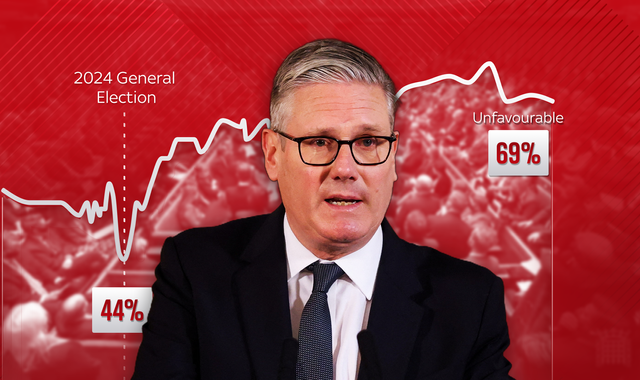
Despite this, Sir Keir remains unpopular overall, with 69% viewing him unfavourably in late April according to polling by YouGov - down from a peak of 75% in January.
Ultimately it is the prime minister's popularity with the public - and future electability - that will be at the front of Labour MPs' minds.
Compared to other recent resigning prime ministers after a similar length of time in office, Sir Keir Starmer is less popular than all but Liz Truss, at -40% approval overall.
The Data and Forensics team is a multi-skilled unit dedicated to providing transparent journalism from Sky News. We gather, analyse and visualise data to tell data-driven stories. We combine traditional reporting skills with advanced analysis of satellite images, social media and other open source information. Through multimedia storytelling we aim to better explain the world while also showing how our journalism is done.

(c) Sky News 2026: The charts that tell us why Starmer is facing a leadership crisis
 King visits Golders Green to show solidarity with Jewish community
 Nigel Farage bought £1.4m property after receiving £5m gift from British crypto billionaire, Sky News learns
 China issues warning over government's plan to nationalise British Steel
 Princess of Wales visits nursery in Italy to learn about innovative teaching methods
 GDP figures show unexpected growth, as Reeves warns 'now is not the time to put economy at risk'
 Police identify three women whose bodies were recovered from sea off Brighton coast
 Revolut targets summer launch for private banking service aimed at British customers | Mark Kleinman blog
 Women turning to loan sharks due to debt racked up by abusive partners