
Storm Goretti - the first named storm of the year - has hit the UK and brought with it a "weather bomb".
The phenomenon, also known as explosive cyclogenesis or bomb cyclone, can result in snow and winds strong enough to bring down trees and cause structural damage.
Ahead of Storm Goretti, a rare red weather warning - which warns of a danger to life - was issued by the Met Office, covering Cornwall, the Isles of Scilly and Jersey.
This warning has now ended, but amber and yellow warnings remain in place for millions of people across the UK.
Although a weather bomb is not directly linked to weather warnings, the two can be connected.
Storm Goretti live updates
What causes a weather bomb?
The process has been likened to when ice skaters spin faster by drawing their arms in, according to the Met Office.
Sky News weather producer Jo Robinson says a weather bomb is caused by a storm "deepening".
That's when the central pressure of a storm drops by 24 millibars [a millibar is a unit of atmospheric pressure] or more over 24 hours, Robinson explained.
In the case of Storm Goretti, it is likely to "deepen close to 40mbs in the 24 hours between midnight Thursday and midnight Friday," she added.
The Met Office explains that when a rapid acceleration of air caused by the jet stream high up in the atmosphere removes air from the storm column, reducing its weight, it causes pressure to fall at sea level.
This, in turn, sucks in air which converges from surrounding regions - resulting in faster and faster rotation of the circulation.
The resulting winds peak over a period of a few hours and can be strong enough to cause significant damage, the forecaster adds.
How often do they affect the UK?
The UK has experienced numerous weather bombs in the past.
In 2017 Storm Doris moved across the UK, bringing gusts of up to 94mph and heavy snowfall.
Northern England was also hit by a weather bomb in 2014, when waves measuring 52ft high - considered "phenomenal" on the Douglas Sea Scale, which classifies sea conditions - were recorded off the Outer Hebrides.
Gale-force gusts of more than 80mph also struck some northern coastal areas.
Are weather bombs dangerous?
Weather bombs do not always mean there is a risk to life. Sometimes they can behave like conventional winter storms.
Other times they produce heavy flooding, blizzard conditions and high wind speeds.
Read more:
What are weather warnings and how do they work?
How cold is too cold to go to work?
Cheap and easy tips for keeping warm
Daniel Swain, a climate scientist at the University of California, previously told Sky News that much of the danger lies in the fact that a weather bomb can take people by surprise.
He said: "Fundamentally, the impacts of a bomb cyclone are not necessarily different from other strong storm systems, except that the fast strengthening is usually a signature of a very powerful storm system."

(c) Sky News 2026: What is a weather bomb and how often do they affect the UK?
 Can Zack Polanski's anti-establishment message beat Nigel Farage on migration?
 Video from 'deeply personal' series released on Kate's birthday
 Starmer says 'more could be done to protect' the Arctic amid 'Russian aggression' in call to Trump
 Probe into police response to attack linked to Huntingdon train stabbings
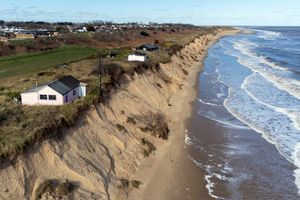 Clifftop residents told to leave because Storm Goretti could destroy their homes
 Increasing numbers of women are dying during pregnancy or in the weeks after giving birth
 Watchdog to examine West Midlands Police role in Maccabi Tel Aviv fans ban
 Anthony Joshua pays tribute to 'special' friends killed in Nigeria crash