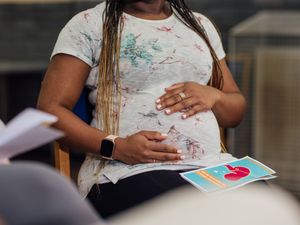

The NHS has announced every maternity service in England will have to upend clinical standards to reduce the number of women who die during or after pregnancy.
Increasing numbers of women have been reported to be dying during pregnancy or in the weeks after giving birth.
According to the latest official data, there were 252 maternal deaths from 2022 to 2024 – 20% higher than the rates from 2009 to 2011. This is the equivalent of 12.8 deaths for every 100,000 women giving birth.
NHS England's chief midwife Kate Brintworth told Sky News that, while improvements were being made, "none of us think care is in the right place".
"We don't think that things are good enough," she said.
Read more: Your birth trauma stories
"It's a terrible anguish to lose a child," she added. "I think it's one of the worst things that can happen to a human, and our responsibility as leaders in maternity is to make sure those families don't experience that anguish."
Ms Brintworth hopes today's announcements will ensure avoidable deaths are "significantly" reduced.
What's been announced?
The NHS says it will become the first healthcare system in the world to offer all pregnant women an early risk assessment for venous thromboembolism before their first antenatal appointment by next March.
The condition refers to blood clots that form in deep veins, which are now the leading cause of maternal deaths.
Anyone identified as being at high risk will be offered blood thinners to prevent clots within 72 hours.
Other changes to be brought in by March 2027 include giving every woman with epilepsy access to a local specialist team for managing the disorder in pregnancy, a tailored plan to help control seizures, and timely access to medications that are safe to use in pregnancy.
Women are also set to be routinely assessed for their mental health and referred to a specialist NHS perinatal mental health service if needed.
And those experiencing a haemorrhage or significant bleeding after birth will receive care from specialist obstetricians and anaesthetists sooner.
It comes after Health Secretary Wes Streeting accused the NHS of having an "appalling culture of medical misogyny" as he set out a range of measures in a renewed Women's Health Strategy.
The NHS expects the full rollout of the measures in England will reduce the number of deaths caused by blood clots, strokes, cardiac disease, suicide, sepsis, obstetric haemorrhage and pre-eclampsia.
These account for 52% of maternal deaths.
It's also hoped it will tackle maternal suicides, which remained the leading cause of death occurring between six weeks and one year after the end of pregnancy between 2022 and 2024, accounting for 33% of deaths.

(c) Sky News 2026: NHS to overhaul maternal care in England to tackle pregnancy deaths
 PM told to quit as senior civil servant set to face more Mandelson questions
 UK cancer cases reach record high - with a diagnosis every 80 seconds
 Riot police to be deployed to stop small boat crossings
 Chelsea head coach Liam Rosenior sacked after fifth straight Premier League loss
 Two more arrested over arson attack plot targeting Jewish community
 Singer D4vd's alleged murder victim died from penetrating injuries, post-mortem finds
 Pope tells prisoners in Equatorial Guinea 'you are not alone'
 Tesla surprises Wall Street and says demand for vehicles has returned