

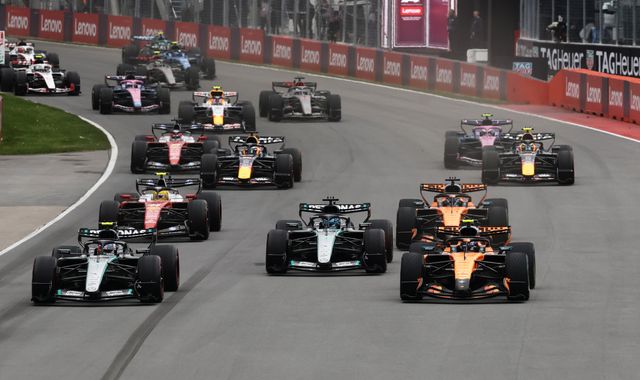
Formula 1 bosses have agreed to make changes to the sport's engine regulations for the 2027 and 2028 seasons which will see an increase in internal combustion output.
The 2026 season has seen a near-50-50 split between internal combustion and electrical power as part of the sport's new ruleset. For the 2027 season, the split will be 58-42 for the former and will increase to 60-40 in 2028.
The impact of F1's new engine regulations has been a constant topic of debate in the sport since the start of the year, with drivers - notably Max Verstappen - having been particularly critical of the way they are having to manage electrical power during a qualifying lap.
- Barcelona-Catalunya GP: UK schedule and how to watch on Sky Sports
- F1 2026 standings | F1 2026 Calendar | F1 Gossip Column
- Download the Sky Sports app for expert analysis, best video & more?
- Not got Sky? Get Sky Sports or stream with no contract on NOW?
In a bid to get drivers back closer to pushing flat-out in qualifying, but while preserving the increase in overtaking seen so far this year in races, the sport's stakeholders - the FIA, F1, the teams and engine makers - have held a series of meetings aimed at finding ways to refine the rules.
Initial tweaks have already been introduced this year and, on Wednesday, the FIA announced agreement had been reached for a phased two-step process for more fundamental change to move to a 60-40 engine split by 2028.
An agreement in principle on a 60-40 split from as early as next year had previously been announced last month, although it was pending further discussions on the detail with engine manufacturers.
Some manufacturers, including Audi and Ferrari, subsequently were thought to want a longer glide path to make the changes required to get to 60-40, which will now happen by 2028.
In a statement, the FIA said: "The agreement follows discussions held since the opening races of the 2026 season, following concerns identified in relation to energy management under the new Power Unit framework.
"The proposed changes are intended to address issues related to energy management and fuel energy flow characteristics and make Qualifying more flat-out while not impacting the positive and exciting racing generated by the new regulations.
The agreed proposals will now go to the World Motor Sport Council to be rubber-stamped on June 23, with the FIA promising to "expedite the formal approval process to provide all parties with early clarity and sufficient time to adapt to the revised requirements".
Will engine changes make Verstappen F1 stay more likely?
While all drivers will likely welcome moves to return qualifying to a more intuitive challenge, the views of four-time world champion Max Verstappen on the latest rules agreements are likely to be particularly keenly sought by the media at this weekend's Barcelona-Catalunya Grand Prix.
The Red Bull driver has been the most outspoken critic of the current engine rules and suggested on several occasions this year that they could see him leave the sport at the end of this year as he is taking less enjoyment from driving the 2026 cars.
But the Dutchman dropped his biggest hint yet last month that he would stay on into 2027 when news first emerged about the original agreements in principle for next season.
"It's definitely heading into a very positive direction. I think it's the minimum I was hoping for. I think it's really nice that's what they want to do. That's definitely what I think also the sport needs," said Verstappen.
Asked if it would boost his chances of staying in F1 next year, he added: "Yeah, definitely. I just want a good product in Formula 1, and that will for sure improve the product.
"What I said before with the changes, hopefully that will happen next year, that will already help a lot. I've always said it doesn't matter if I had a good car or not, it's just a product, and I think the product will improve like that, so naturally I think then the enjoyment will go up as well."
Whether the fact that the full 60-40 switch will now not be completed for a further year will change his optimism in any way is less clear, although the Dutchman is likely to be asked his thoughts as soon as Thursday when he speaks on media day in Spain.
How will the engine ratio be changed?
The FIA detailed how the phased rebalancing of power output will be achieved.
From a current level of 400kW, the maximum power of the V6 internal combustion engine will increase to 420kw by 2027 and 450kW by 2028. The engine's fuel-flow rate will increase by five and 13 per cent respectively.
In turn, the maximum power of the electrical MGU-K will decrease from the current level of 350kW to 300kW from next year. The maximum harvesting power will increase from 350kW now to 375kW next year and 400kW in 2028.
The FIA added that "supporting measures relating to power unit supply conditions, race operations and the relevant financial regulations are also included" in the agreement.
Formula 1 heads straight to Spain for the Barcelona-Catalunya Grand Prix with live coverage on Sky Sports F1 from this Friday. Stream Sky Sports with NOW - no contract, cancel anytime
(c) Sky Sports 2026: Formula 1 agree engine rule changes for 2027 and 2028 seasons in move away from 50-50 power split
 Kieran McKenna stepping down as Ipswich boss to take a break from football amid Fulham interest
 Everton appeal order to pay Burnley £35m in compensation over PSR breaches in June 2022
 World Cup 2026: Why Thomas Tuchel said England are not favourites to end 60 years of hurt in USA, Canada and Mexico
 The F1 Show: FIA decision to grant pace-setting Mercedes engine upgrade questioned by Sky Sports F1's David Croft