Blood tests that could spot the early signs of a range of the most common cancers are to be trialled on thousands of NHS patients.
More than 20,000 people in 200 GP surgeries across England are set to take part in the plan which will use some of the latest technology - including artificial intelligence and measuring proteins in the blood.
The tests, which will be given to patients in the "world-leading" new trial named STRIDE-RCT, will be assessed to see if they can detect prostate, ovarian, bowel, pancreatic, stomach, liver, and other abdominal cancers.
They are designed to pick up signals in the blood to indicate whether a person may have cancer and needs further investigation, or whether they can be safely ruled out as having the disease.
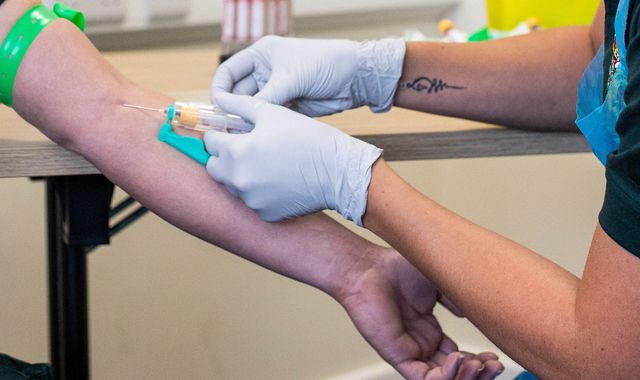
Most of the tests in the trial, developed by the University of Birmingham, will ask patients to have one or two tubes of blood taken at their GP practice, alongside routine blood tests.
If successful, it could mean cancers are identified earlier via a simple blood test ordered by a GP, and reduce unnecessary referrals to hospital for invasive tests.
What are the tests?
The first four companies in the trial are Proteotype (Enlighten test), Pinpoint AI (PinPoint test), Natera (Signatera test) and Mercy Bioanalytics (Halo test).
The Enlighten test is for people who may have vague symptoms or who are known to be at increased risk of cancer.
It could identify signs of breast, bowel, lung or prostate cancer by measuring patterns of circulating amino acid biomarkers in human plasma.
The Pinpoint AI test analyses 32 biomarkers all at once, working to combine weak cancer signals in the blood to generate one strong test result.
It can be used to pick up signs of bowel, ovarian and lung cancer, as well as pancreatic cancer, liver cancer, bile duct cancer and stomach cancer, according to early testing.
Results from the test are returned to the doctor with a colour-coded indication of future treatment of either red (high risk; prioritise), amber (average risk; continue standard assessment) or green (low risk; rule-out).
The Signatera test is already used for picking up cancer that has come back, and is based on circulating tumor DNA (ctDNA) fragments shed into the blood by tumours.
The Halo test examines particles called single extracellular vesicles, which circulate at high levels in the blood even in early-stage cancer.
Who is eligible?
People aged 45 and over who visit their GP with abdominal symptoms, such as persistent bloating or discomfort, will be given the chance to try one of the tests.
Around 71,000 people are diagnosed with pancreatic, stomach, liver, ovarian or bowel cancer in England each year, and there are almost 35,000 deaths from these cancers, the Department of Health said, noting that "abdominal cancers are often found too late".
More from Sky News:
Trump's reaction to election defeat - latest
Fraud spotting to be taught in schools
Warning over Parliament's future
Health Secretary Yvette Cooper said: "The earlier cancers are diagnosed, the more chance they can be successfully treated, and lives can be saved.
"This world-first trial will establish whether simple blood tests can help GPs identify much sooner the patients who need urgent support."
Professor Peter Johnson, NHS national clinical director for cancer, called it a "revolution in cancer diagnosis" which will show if whether blood tests "can help GPs get the right patients to the right tests sooner".
Michelle Mitchell, chief executive of Cancer Research UK, said the trials will be "an important step" towards helping GPs decide whether patients need further testing.

(c) Sky News 2026: Blood tests that could spot early signs of cancers to be trialled on thousands of NHS patients<
 Health checks offered to Wigan residents near one of England's worst illegal waste sites
 Just 13% of UK teenage girls active every day, WHO figures show
 Cyber attacks affect UK meat processing industry, top security official says
 AI toys 'should be banned' over child harm fears, say MPs - as they urge retailers to remove them