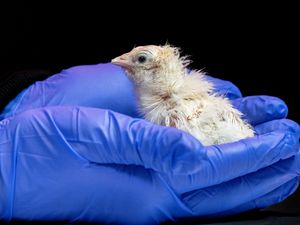

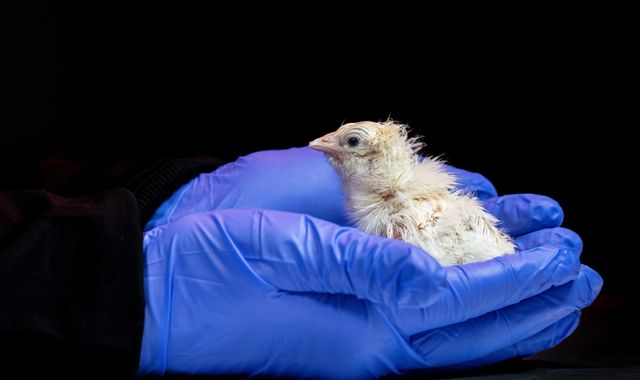
What came first: the chicken or the egg? Controversial de-extinction firm Colossal Biosciences claims to have answered that question by hatching its first chicks from an entirely artificial egg.
The tech startup calls it a giant leap forward in its attempt to resurrect the now extinct, 230kg New Zealand moa bird, whose enormous eggs could not be replicated today.
"It's a major milestone for Colossal and a foundational technology for our de-extinction toolkit," said CEO Ben Lamm.
He is the billionaire startup veteran who founded Colossal Biosciences, which shocked and thrilled the world with various claims to have de-extincted the dire wolf or that it would bring back the woolly mammoth.
In a slickly produced YouTube video - which apes the film 2001: A Space Odyssey - Colossal explains how it removed a chicken embryo from a real egg, and then incubated it in an artificial construction until it hatched.
The biosciences company says the system is "fully scalable and biologically accurate" - so could be scaled up to hatch an embryo from, say, a moa, or an existing but endangered bird species.
In the past, scientists have attempted to develop a fake egg, but struggled to allow air flow through the "shell" in the right way.
Colossal's invention is made from a lattice shell structure and a silicone-based membrane that "matches the oxygen transfer capacity of a natural eggshell", it said.
If as successful as claimed, it is a feat "for which there are no comparable precedents", said Carles Lalueza-Fox, specialist in DNA recovery techniques.
But he and others raised eyebrows at the announcement.
Unusually for a scientific breakthrough, it has not been published in a journal, meaning it has avoided the scrutiny of other experts in the peer review process.
Dr Louise Johnson, evolutionary genetics expert at Reading University, said the news "sounds impressive" but, until there's a peer-reviewed paper, she "might as well give expert commentary on a YouTube ad".
Others are dubious about how big a breakthrough in de-extinction this represents, or whether de-extinction is needed at all.
Dusko Ilic, professor of stem cell sciences at King's College London, called it a "technically interesting development" but said there were still many steps to go, including reconstructing the animal's genome and behaviour.
That makes the technology more valuable if it were used for something like endangered bird conservation, he added.
Colossal said its ability to incubate bird embryos outside of a natural shell is "a capability conservation programs simply don't have today".
"We're building it for the moa, but it's designed to support critically endangered species broadly," said Matt James, its chief animal officer.

(c) Sky News 2026: De-extinction firm Colossal Biosciences has 'hatched first chicks fro
 Elon Musk loses lawsuit against OpenAI
 Swatch x Audemars Piguet launch sparks crowd trouble outside shops: What happened?
 'Everyone is doing it': The dark art of GPS jamming in the Iran war
 Final moments of Altman v Musk trial as jury decides fate of AI titans