

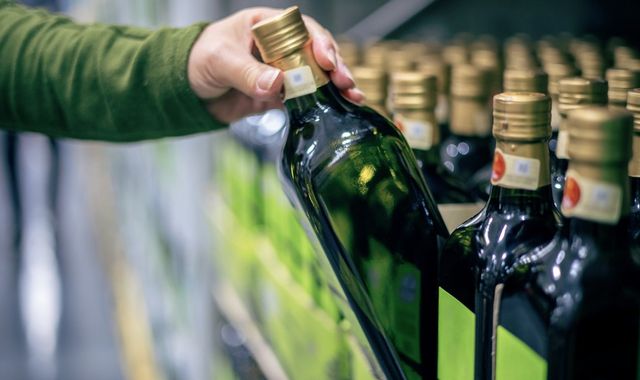
Olive oil has become a kitchen staple in the UK - but how many of us actually know what we're looking for?
Maybe you've heard dark bottles are preferable, but there's much more to picking the right one, experts have told us.
Jerome Schehr, head of production at Krude, an olive oil company co-founded by Gordon Ramsay, says there are five key things to look for...
• A harvest year
• The country (or even region) of origin
• The olive variety, where available
• Packaging that protects the oil from light
• Information about early harvest or cold extraction
We'll go in depth on each of these, and more, in this piece.
The crayon test
Sarah Vachon, olive oil sommelier, says harvest date is key - not best before, which only tells you when it was bottled and nothing about the freshness.
"Most people now know they should never buy a clear container as light damages the oil, but they're less aware of the degradation that happens over time," Vachon says.
"Once a bottle is opened, you should have it within three months. For me, I prefer no more than 45 days - especially since I'm wanting to capture the most polyphenols and their anti-inflammatory benefits in my diet.
"Those nutrients, and then in turn the flavour, are what you really lose by not storing and using your oil quickly enough."
Find more consumer news and tips in the Money blog
Almost all of the experts we spoke to compared olive oil to wine.
"Once opened, the bottle should be closed tightly after every use, it's like wine left open, it really will degrade," says Schehr.
Chef and food author Helen Graham says you can tell if an oil has gone bad "if it's smelling sour or crayon-like".
Avoid oils that hide origin
Most data in the UK will tell you that Italy is a "favourite" country for shoppers in theory - but also that the British palate prefers a milder taste profile for their extra virgin olive oil.
And that's where many Britons go wrong.
Vachon says: "From a flavour perspective, extra virgin olive oils from Greece often can be more delicate, whereas oils from southern Italy are more intense.
"It's not always the case, but it's often the styles they go for with their local cultivars."
Jerome Schehr, from Krude, says countries such as Portugal, Australia and parts of California are increasingly making world-class oils.
That said... "Rather than focusing solely on country of origin, consumers should look for oils with a clearly stated provenance, ideally from a single country, region or estate. Transparency is usually one of the strongest indicators of quality."
Consumers should also be cautious of vague statements such as "packed in" or "blend of EU oils" without any additional transparency.
"These aren't necessarily signs of poor quality, but they don't tell you much about where the olives actually came from," says Schehr.
Different dishes, different oils
Andy Beynon, chef patron of Michelin-starred Behind restaurant in London, says the olive oil you buy should depend very much on the dish you're pairing it with.
"A delicate extra virgin olive oil is great with lighter dishes, delicate fish, salads and vegetables where you don't want the oil to overpower everything else," he says.
"A medium-intensity extra virgin olive oil is a great all-rounder for things like seafood and roasted vegetables. Then you have those really robust, peppery extra virgin olive oils, which are fantastic when you want the oil to make more of a statement.
"For dressings, I like to keep things simple, good olive oil, plenty of vinegar and proper seasoning. The acidity cuts through the richness of the oil and keeps everything fresh. For dipping, I'd go for something with a bit more personality like a chilli or garlic extra virgin olive oil."
The bottle
Dark glass and high-quality tins are both excellent choices.
"Dark glass helps protect against UV light while still allowing consumers to see the product, but it is heavier for transport and therefore harder on the planet regarding emissions," says Schehr.
"Tin offers even greater protection because it blocks light completely and is lightweight, making it ideal for preserving freshness throughout the product's life."
The right and wrong kind of plastic
"Plastic is also nuanced," says Vachon, the sommelier. "Obviously clear plastic bottles are a big no-no; they don't work safely even for water over time, so of course they won't with oil.
"Mono-plastic materials are gas-permeable, so oxygen migrates in through the walls, and then the good compounds migrate out. Studies also show losses of more than 50% of total antioxidants within three to six months in standard PET versus dark glass."
But... "Multi-layer plastics, such as the material used in baby food and wine bag-in-box, have found comparable shelf life to that of dark glass bottles."
Cold-pressed
Cold-extracted olive oil is produced mechanically at temperatures below 27C, helping to preserve its natural flavour, aroma and some heat-sensitive beneficial plant compounds.
This can help retain antioxidants, such as polyphenols, and contribute to a fresh, fruity taste, although the final quality and antioxidant content also depend on factors such as olive variety, harvesting and storage.
Read more from our Buy like a Pro series:
Best time to book, packing tricks and cheaper flights
Don't buy air conditioning until you've read this
The problem with supermarket honey - and what you should look for
You should generally prioritise a good-quality extra virgin olive oil, as this is the highest grade and must be obtained solely by mechanical or other physical means. The term "cold extraction" provides additional information about the production temperature, but does not guarantee superior quality on its own.
The perfect price
The cost of olive oil was a recurring theme of the cost of living crisis caused by the Ukraine war.
Schehr offers this guide...
• Under £8 for 500ml often requires compromises
• Between £12 and £30 for 500ml is where many excellent premium oils sit
• Above that, consumers should expect genuine added value through exceptional provenance, rare varieties, very early harvests or limited production
Spray bottles
Olive oil sommelier Vachon says the same rules apply to this format. But...
"I would only use this format in conjunction with others, like a typical bottle to pour on other dishes, since you can't easily hit the recommended daily dose of extra virgin olive oil (based on all the clinical trials and research) to get the optimal benefits of the antioxidant and anti-inflammatory effects with a tiny spritz. It needs a decent drizzle at mealtimes across your day."
Consumers should check the ingredient list carefully.
"Some spray products contain refined oils with chemicals, propellants or additives," says Schehr.
'Light' olive oil doesn't mean fewer calories
Many consumers believe "light" olive oil contains fewer calories, but that's not the case, says Schehr.
The term usually refers to flavour and colour, not nutritional value. Light olive oil is generally refined olive oil that has been processed to remove much of its flavour, aroma and colour before being blended with a small amount of virgin olive oil.
Extra virgin olive oil, by contrast, is obtained solely through mechanical extraction without chemical refining. It retains its natural aromas, antioxidants and polyphenols.
The pepper test
The advice in this piece is all well and good, but what should good olive oil actually taste like?
"The best way is to taste it on its own," says chef Benyon. "A good olive oil should have depth and a peppery finish, you should get plenty of flavour rather than just oiliness. A poor-quality oil can taste flat, greasy or almost watery, without much character. For me, that peppery hit at the end is a really good sign of a quality extra virgin olive oil."
Recommendations from the best
We asked our experts, plus top chefs and food authors, for their recommendations.
Chef Andy Beynon: "I'm a big fan of Citizens of Soil. For me, the best olive oils have real character and aren't just there to add fat, you want something with freshness and depth."
Emily Roux, co-owner of Michelin-starred Caractere Restaurant in London, says: "My favourite supermarket brand would be Filippo Berio extra virgin olive oil. This is my default olive oil that's great for salad dressings, dipping, finishing off a plate of pasta, vegetables or fish, anything where you want to taste a good quality olive oil.
Schehr, from Krude, says: "Castillo de Canena consistently produces exceptional oils with remarkable freshness and balance. They invest heavily in quality, traceability and innovation, and it really shows in the final product."
Chef and food author Helen Graham says: "My favourite olive oil is Honest Toil produced from small farms in Greece - it's cold-pressed and unfiltered and I've been working with them since the beginning of Bubala back in 2018.
"It's special enough to be a garnish oil but also great for cooking too, so I go through a lot. They do refillable glass bottles, so it actually is pretty cost-effective.
"You can also pick up Belazu olive oil on Ocado - their Early Harvest oil is great. I would also really recommend the Duchy Organic oil from Waitrose - it's a bit more mellow than the rest but amazing quality."

(c) Sky News 2026: The 'crayon test' and the wrong plastic: Read this before buying your next olive oil
 Charles Bronson refused parole for ninth time
 Prison sentence for teen e-biker who killed woman, 86, increased after appeal
 UK weather: Snow warning in place for parts of country this morning
 Rockstar Games sacked workers to prevent union gaining 'leverage or power', tribunal told
 British Airways flight veers off runway before take-off
 UK sanctions eight firms building Israeli settlements in the West Bank
 A tip to knock £57 off your energy bills | Money newsletter
 Americans urged to 'keep a low profile' in UK amid terror threat over festive season